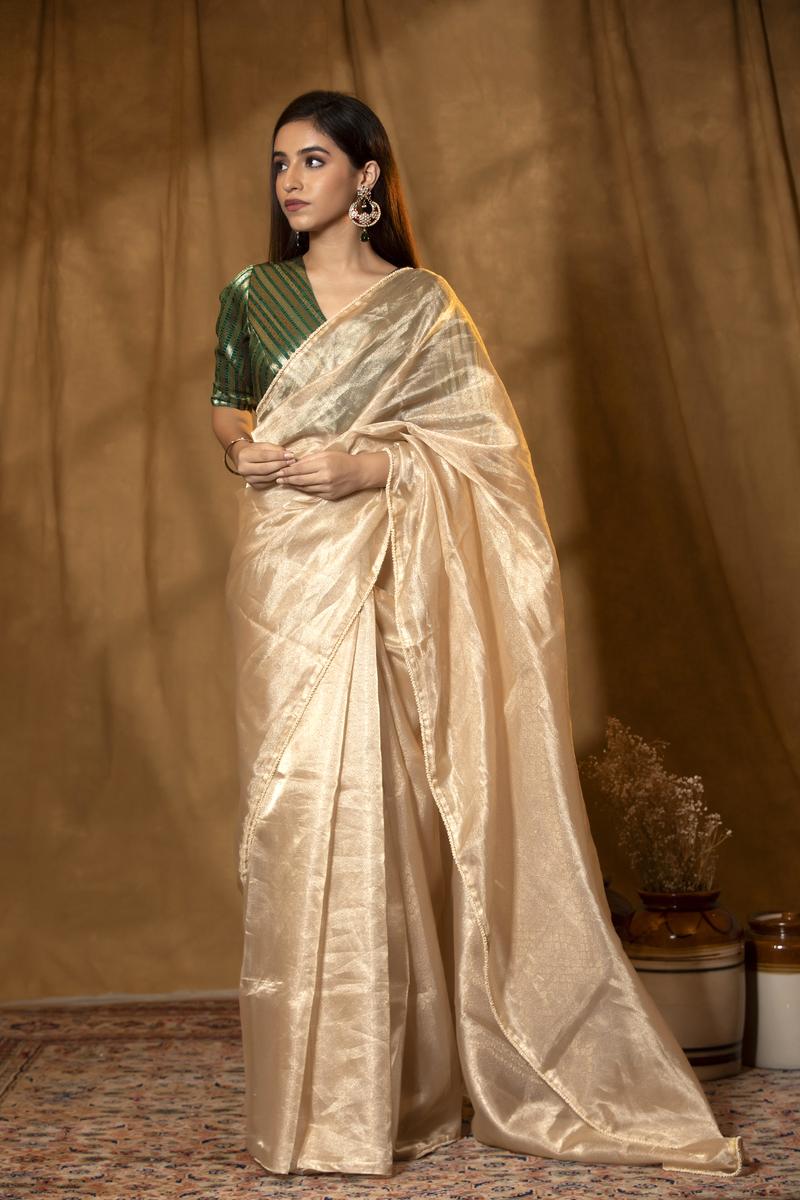
You’ve seen them at weddings and festive gatherings: sarees that catch the light with a soft, molten shimmer, drape like liquid, and weigh almost nothing. They look effortless. But when you start shopping for one, the effortlessness disappears. The listings look alike, the prices swing wildly, and nobody explains why one piece costs three times another.
If you have ever felt unsure about what you’re paying for, you’re not alone. Banarasi tissue silk sarees are among the most admired weaves in Indian textiles and also among the most imitated. This guide will help you understand what makes them special, evaluate quality with confidence, and buy something you will wear and treasure for decades.
What Makes Tissue Silk Sarees Special?
The word “tissue” has nothing to do with paper. It describes the fabric’s sheerness and its metallic glow. In a traditional tissue weave, fine silk threads are combined with zari, which is metallic thread traditionally made by wrapping silk with silver or gold-toned filament. Zari is used in the weft, and it creates that luminous, almost translucent surface.
The result is a fabric that is light, airy, and softly reflective. Unlike heavier brocades, tissue silk sarees drape gracefully and suit warm weather and long events. They are a favorite for weddings, receptions, festivals, and formal celebrations.
The Banaras connection
Banarasi weaving has been practiced for generations in and around Varanasi, where master weavers work on handlooms and power looms to produce motifs inspired by Mughal and Indian design traditions. When a Tissue Silk saree is woven in this tradition, you typically see:
-
Jaal patterns: intricate, interlocking floral or vine designs spread across the body
-
Buta and butis: small motifs scattered across the fabric
-
Kadhua or kadhwa technique: each motif is woven separately into the fabric, which gives clean, defined detail
-
Rich borders and pallus: where the heaviest zari work usually appears
Understanding these details matters because they are exactly what separates a genuine weave from a printed or machine-imitated lookalike.
Handloom versus power loom
A handloom piece can take days or even weeks to complete, depending on the complexity of the design. A power loom piece is produced faster and is usually more affordable. Both can be legitimate. The key is knowing which you are buying, and whether the price and the description are honest about it.
A Practical Framework for Choosing Your Saree
Instead of buying on impulse, run any saree through these five checks.
1. Occasion and weight
Start with where you’ll wear it. For a daytime wedding or a summer festival, a lighter weave with subtle zari will feel comfortable. For an evening reception, a richer pallu and heavier border can make a statement. Tissue silk sarees are naturally lightweight, but the density of the zari work still varies a lot between pieces.
2. Colour and zari tone
Gold zari warms up jewel tones, ivory, and pastels. Silver zari pairs beautifully with cooler shades such as powder blue, lilac, and grey. Consider your skin tone and the jewellery you plan to wear. A good colour choice will still look right years from now, while a trendy shade may not.
3. Weave and motif quality
Look closely at the design. Motifs should be clear and evenly spaced, with clean edges. On the reverse side, a genuine weave shows neat thread movement, and any floating threads should be tidy rather than messy. Blurry patterns or stiff, plasticky texture are warning signs.
4. Fabric feel and drape
Hold the saree and let it fall over your hand. A quality tissue weave should feel soft, slightly crisp, and flowing. If it feels rough, overly stiff, or unusually shiny in a flat, artificial way, it may contain a high proportion of synthetic fibre.
5. Budget and long-term value
Set a realistic range before you shop. Price reflects fibre content, zari quality, technique, and time. A very low price for a supposedly handwoven Banarasi piece should make you ask questions rather than celebrate a bargain.
Example: Choosing a Saree for a Winter Wedding
Imagine Meera, who has been invited to her cousin’s evening wedding in December. She wants something elegant but doesn’t want to look overdressed or feel weighed down during a long ceremony.
She applies the framework:
-
Occasion: An evening event, so she can go slightly richer in detail.
-
Colour: She considers an antique gold zari on a deep emerald base, which complements her family’s gold jewellery.
-
Weave: She checks that the border motifs are crisp and the pallu carries a well-defined jaal.
-
Feel: She drapes the fabric over her arm to confirm it flows without stiffness.
-
Budget: She compares two options in her range and asks each seller about fibre content and weaving method.
She ends up choosing a Banarasi tissue silk saree that feels festive without being heavy. Because she judged it by structure and quality rather than just a photograph, she gets a piece she can restyle with different blouses for years.
Trust and Buying Guidance
Authenticity matters, and a few habits will protect you.
Ask direct questions. Is it handloom or power loom? What is the fibre composition? Is the zari real metallic thread or a coated alternative? A reputable seller will answer clearly and without hesitation.
Look for certification marks. India’s Handloom Mark and Silk Mark labels exist to help buyers verify claims. They aren’t the only signal of quality, but they add a layer of reassurance. Also, Banarasi textiles carry a Geographical Indication (GI) tag, which recognises the region’s weaving heritage.
Inspect real photos and details. Close-ups of the border, pallu, and reverse side tell you more than a styled hero image. If a seller shows only distant, heavily filtered pictures, ask for more.
Check the return and care policy. A trustworthy seller explains how to care for the piece and what options you have if it doesn’t match the description.
Care for it properly. Dry cleaning is generally the safest choice for tissue silk. Store the saree folded in a soft cotton or muslin cloth, away from direct sunlight, and refold it periodically along different lines so the zari doesn’t crease and wear along one fold. Keep it away from perfumes and moisture.
Final Thoughts
A well-chosen Banarasi tissue silk saree is more than an outfit. It carries craft, patience, and heritage in every thread. When you understand the fabric, evaluate the weave, and ask the right questions, you stop guessing and start buying with confidence.
If you’d like to explore authentic options with transparent details, Chinaya Banaras offers a thoughtfully curated collection of tissue silk sarees rooted in Banarasi weaving tradition. Browse at your own pace, compare the details we’ve discussed here, and choose the piece that feels right for your occasion and your style.